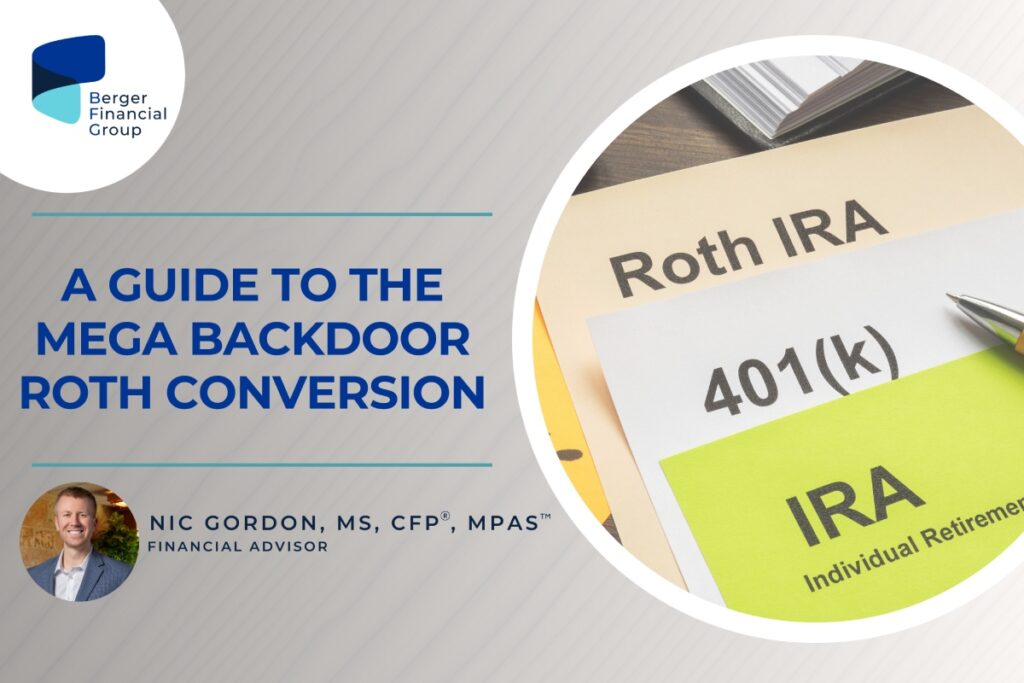
The “mega backdoor Roth conversion” is an advanced strategy that allows certain high-earning individuals to significantly boost their Roth retirement savings far beyond the standard annual contribution limits. It’s a powerful tool, but it requires specific plan features and careful execution.
Who is This Strategy For?
This strategy is particularly beneficial for high-income earners who have maxed out their other retirement savings options and want to save more in a tax-advantaged account.
It is only viable if your employer’s 401(k) plan allows two key features:
- After-tax contributions: The ability to make voluntary non-Roth after-tax contributions in addition to standard pre-tax or Roth contributions.
- In-plan conversions: The ability to immediately convert those after-tax contributions into a Roth account (either within the 401(k) or rolled into an external Roth IRA).
If your employer’s plan does not offer these features, this strategy is not available to you.
Key Features and Points to Be Aware Of
The core idea is to use the extra “room” in your 401(k) contribution limit.
- Total 401(k) limit: The IRS sets a much higher total annual limit on all contributions to a 401(k) plan (employee pre-tax/Roth, employer match, and after-tax). For 2025, this limit is $70,000, or $77,500 for those aged 50-59 or 64 and over (with catch-up contributions).
- The “Mega” part: After you contribute your standard employee maximum (for 2025, $23,500, or up to $31,000 if 50 or older), and factor in your employer’s match, the remaining difference up to the total limit can be filled with voluntary after-tax contributions.
- Immediate Conversion: You then immediately convert these after-tax dollars to Roth. This is crucial because any investment gains on the after-tax contributions become taxable if they have accrued before being converted.
Limits to Know
- Annual Limit: The total amount you can contribute across all sources to a 401(k) in 2025 is $70,000 ($77,500 or more with applicable catch-up contributions). Your personal “mega” contribution limit depends on how much you and your employer are already contributing.
- Plan Rules: You are strictly limited by the specific rules of your employer’s 401(k) plan.
- Highly Compensated Employees (HCEs): HCEs may face additional limits if the plan fails nondiscrimination testing, which can restrict their ability to use this strategy unless the plan has a “safe harbor” design.
Pros and Cons
| Pros | Cons |
| Significant Savings: Allows you to save much more for retirement in a tax-free vehicle. | Complexity: Requires specific plan features and careful execution. |
| Tax-Free Growth: Once converted to Roth, all future withdrawals (contributions and earnings) are tax-free in retirement, provided you meet the requirements. | Administrative Burden: Requires you to monitor contribution limits closely throughout the year. |
| Access to Roth: Provides access to the benefits of a Roth account for individuals who might be over the income limits for direct Roth IRA contributions. | Pro-Rata Rule: While simple for this specific strategy, be mindful of the “pro-rata” rule if you have existing pre-tax IRA money when you attempt an external conversion. |
Summary
The mega backdoor Roth conversion is a sophisticated strategy for maximizing tax-free retirement savings. It offers a powerful way to build wealth, but it’s not universally available and requires attention to detail.
If you believe your financial situation aligns with the potential benefits of this strategy, the next step is to consult with your Human Resources department or plan administrator to verify your 401(k) plan’s specific rules. Then, you should talk with a trusted financial advisor and tax professional to determine if this approach makes sense in your specific circumstances and to ensure proper execution to avoid unintended tax consequences. They can review your plan details and help you incorporate this powerful tool into your overall financial plan to reach your retirement goals.